
Generative engine optimization (GEO) is the practice of making your business and your content easy for AI tools such as ChatGPT, Perplexity, Gemini and Google AI Overviews to understand, trust and cite when they answer a question. Where traditional SEO aims to rank a page in a list of links, GEO aims to make your business part of the answer itself.
If you run a small business, this matters because more of your future customers will ask an AI assistant for a recommendation before they ever click a search result. This guide explains what GEO is, where the idea came from, what the research and Google actually say, and the practical steps I use with clients to improve visibility in AI answers.
Key takeaways
- GEO focuses on being cited and recommended inside AI generated answers, not just ranking in a list of links.
- The term comes from a peer reviewed research paper presented at KDD 2024, which found that adding citations, quotations and statistics improved visibility in AI answers by up to 40%.
- Google says that for its own AI features, good SEO is still the foundation, with no special files or markup required.
- For small businesses, the winning moves are clear answers, consistent business information, real evidence and mentions on trusted sites.
What does generative engine optimization mean?
A generative engine is an AI system that reads several sources and writes one combined answer, often with links to the sources it used. ChatGPT search, Perplexity, Gemini, Google AI Overviews and Google AI Mode all work this way.
Generative engine optimization is everything you do so that these systems pick your content as a source and describe your business accurately. In practice that means publishing clear, factual, well organized information, backing it up with evidence, and making sure the same facts about your business appear consistently across the web.
Where did the term GEO come from?
The phrase was introduced in a research paper titled GEO: Generative Engine Optimization, first posted in November 2023 by researchers from Princeton University, IIT Delhi and independent collaborators, and accepted at KDD 2024, one of the leading data science conferences.
The team built a benchmark of 10,000 real world questions and tested different ways of rewriting web content. Three findings are especially useful for business owners:
- Evidence wins. Adding citations to credible sources, quotations from relevant experts and specific statistics boosted a source’s visibility in AI answers by up to 40%.
- It worked on a live product. The same methods improved visibility on Perplexity by up to 37%.
- Keyword stuffing did not help. Repeating keywords, an old SEO habit, did not improve visibility in AI answers.
The study tested AI systems as they existed in 2023 and 2024, and the authors note that methods may need to adapt as these engines change. Treat the numbers as direction, not a guarantee.
GEO vs SEO vs AEO: what is the difference?
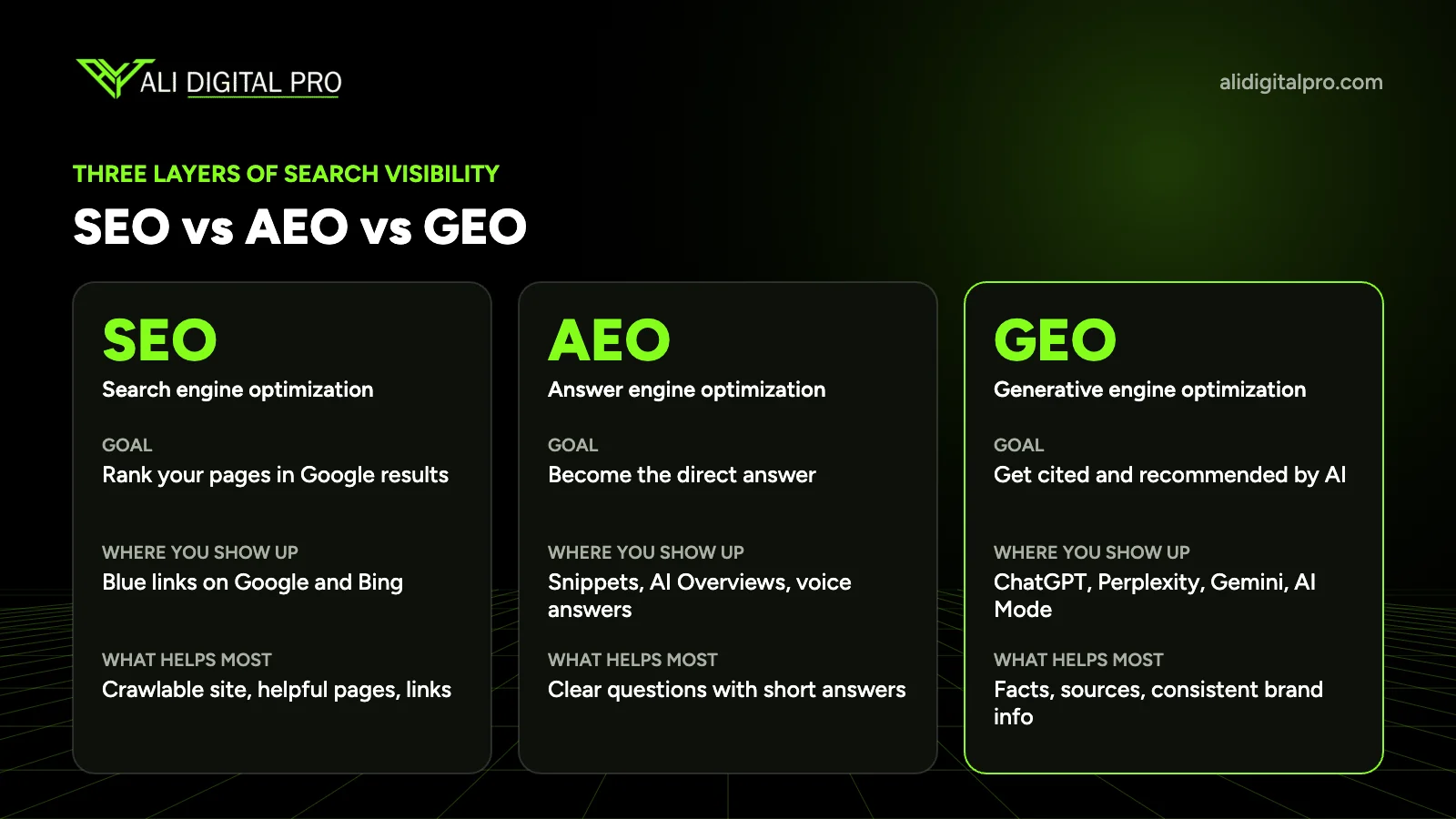
| SEO | AEO | GEO | |
|---|---|---|---|
| Main goal | Rank pages in search results | Become the direct answer | Get cited and recommended by AI |
| Where you appear | Google and Bing results | Featured snippets, AI Overviews, voice assistants | ChatGPT, Perplexity, Gemini, AI Mode |
| What helps most | Crawlable, helpful pages and quality links | Clear questions with short, complete answers | Evidence, sources and consistent business information |
These are not three separate projects. They build on each other. A site that is fast, crawlable and genuinely helpful (SEO) with clear question and answer sections (AEO) already has most of what generative engines look for (GEO). That is why my SEO services include all three.
What does Google say about optimizing for AI search?
In May 2026 Google published official guidance called Optimizing your website for generative AI features on Google Search. Its message is clear: for Google’s own AI Overviews and AI Mode, the foundation is still good SEO.
- There are no extra technical requirements beyond being indexed and eligible to show a snippet.
- You do not need an llms.txt file, special AI markup or content rewritten specifically for AI to appear in Google’s AI features.
- Structured data is still useful for search in general, but there is no special schema for AI features.
- Traffic from AI features is counted in Search Console’s Performance report, inside the normal Web search type.
Other platforms such as ChatGPT and Perplexity may weigh signals differently, which is why the evidence based tactics from the GEO research are still worth applying.
How do AI engines decide which sources to use?
While each product works differently, most follow a similar pattern. The system interprets the question, searches an index for relevant pages, reads the most promising sources, then writes an answer and attaches citations. To be chosen, your page needs to be findable, relevant to the exact question, and clear enough that the AI can confidently lift a fact or recommendation from it.
That is why vague marketing copy rarely gets cited. A sentence like “we deliver world class solutions” gives an AI nothing to use. A sentence like “social media management starts at $449 per month for up to four channels” does.
How to do GEO for a small business: 8 practical steps
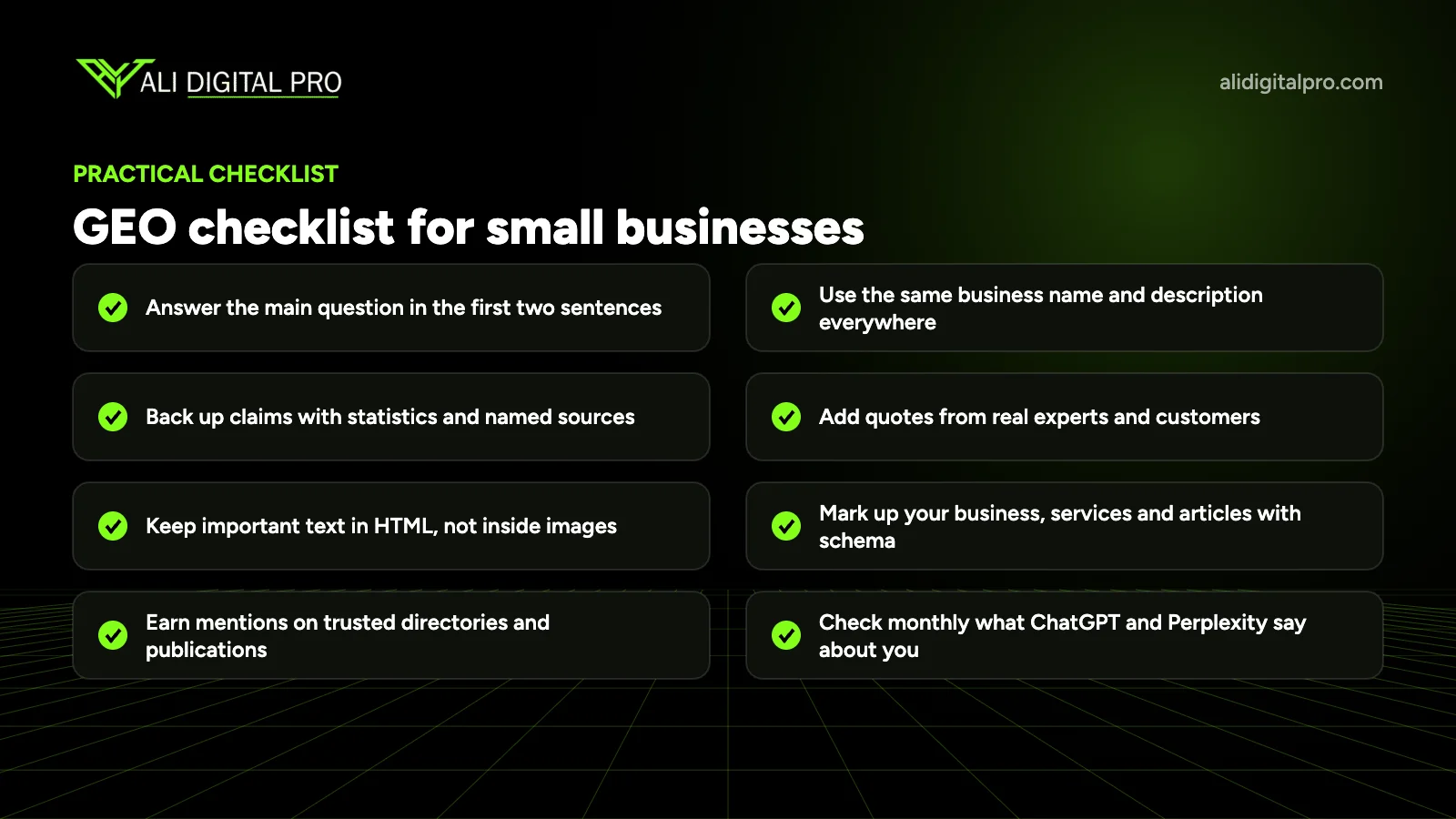
- Answer the main question first. Put a clear, complete answer in the first two sentences of each important page or article.
- Describe your business the same way everywhere. Use the same name, services, location and description on your website, LinkedIn, directories and profiles.
- Back up claims with evidence. Add specific numbers, dates and named sources, and link to the original research.
- Quote real people. Client feedback and expert quotes give AI engines trustworthy material to cite.
- Keep important facts in text. Prices, services and answers should be readable text, not hidden inside images or videos.
- Use structured data. Mark up your business, services and articles with schema so machines can read the key facts reliably.
- Earn mentions on trusted sites. Reviews, directory listings, podcast appearances and press quotes help AI tools confirm you are real and relevant.
- Check what AI says about you. Once a month, ask ChatGPT, Perplexity and Gemini the questions your customers ask, and note whether you appear and how you are described.
Common GEO myths
Myth: GEO replaces SEO
It does not. Google itself says its AI features rely on the same fundamentals as search, and most AI tools still discover content through search indexes. GEO is an extension of SEO, not a replacement.
Myth: an llms.txt file will get you into AI answers
Google states it does not use llms.txt for its AI features. A file like this cannot hurt, but it is not a shortcut. Clear content and real authority matter far more.
Myth: you can buy your way into ChatGPT answers
No reputable provider can guarantee placement in AI answers. Be cautious of anyone who promises it.
How do you measure GEO results?
There is no single dashboard yet. A practical approach for small businesses is to combine three signals: impressions and clicks in Google Search Console, referral visits from AI tools in your analytics, and a monthly record of how AI assistants answer your top ten customer questions.
How I approach GEO for clients
When I take on SEO, AEO and GEO work for a business, I start with an audit of how the site performs in Google and how AI assistants currently describe the business. From there I fix technical issues, rewrite key pages so they answer real questions clearly, add structured data, and build a plan for credible mentions across the web. Progress is reported every month in plain English.
If you want to know how your business shows up in Google and in AI answers today, book a free 30 minute discovery call (opens Calendly in a new tab) and we will look at it together.
Frequently asked questions
Is GEO the same as SEO?
No, but they overlap heavily. SEO helps your pages rank in search results. GEO helps AI tools cite and recommend your business inside their answers. Strong SEO is the foundation that makes GEO work.
Which AI tools does GEO cover?
Any tool that writes answers from web sources, including ChatGPT search, Perplexity, Gemini, Microsoft Copilot, Google AI Overviews and Google AI Mode.
How long does GEO take to work?
Like SEO, it builds over months. Content changes can be picked up quickly, but trust signals such as reviews and mentions on other sites take time to accumulate.
Do small businesses really need GEO?
Yes, if your customers research before they buy. When an AI assistant recommends three providers, being one of them is worth more than ranking tenth in a list of links.
Sources
- Aggarwal, P. et al. GEO: Generative Engine Optimization. KDD 2024.
- Google Search Central. AI features and your website.
- Google Search Central. Optimizing your website for generative AI features on Google Search, May 2026.
- Search Engine Journal. Google’s new AI search guide calls AEO and GEO still SEO.